
What One Law Firm’s AI Visibility Rise Reveals About Generative Engine Optimisation
At the end of February 2026,Burt Brill & Cardens had a problem the firm could not see in Google Analytics.
The Brighton law firm had an established website, experienced solicitors and a long history of advising clients. To a person encountering the firm online, it was clearly a genuine legal practice with recognised areas of expertise.
But ask ChatGPT the kinds of questions a potential client might ask when looking for legal help, and a different picture emerged.
More often than not, the firm was missing.
It was not necessarily being rejected. It was not consistently entering the conversation in the first place.
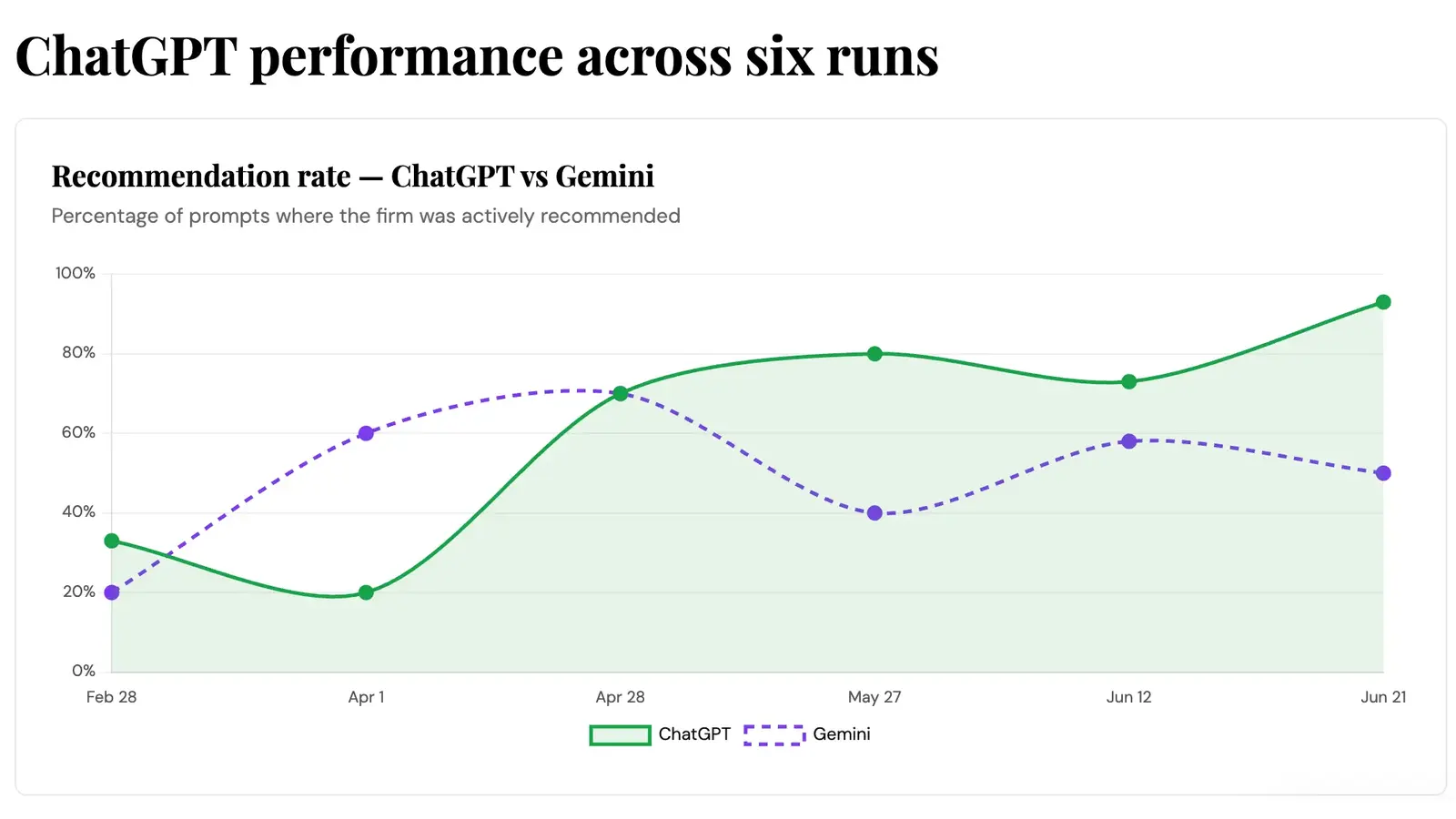
Four months later, ChatGPT was recommending Burt Brill & Cardens in 93% of the monitored searches.
The firm had not changed its name, moved to a new city or reinvented its legal practice. What changed was the way its expertise could be discovered, connected and verified.
That journey offers a glimpse into a new contest for legal visibility, taking place beyond the traditional Google results page.
Visibility no longer begins with a list of links
For most of the internet’s history, being visible online has meant being ranked.
Someone typed “probate solicitor Brighton” into Google and received a list of results. Every firm on that page had an opportunity to attract the click. The higher the position, the greater the opportunity.
Generative AI has changed the shape of that encounter.
A person can now explain their situation to ChatGPT in ordinary language. They might describe a disagreement over a will, mention that they live in Sussex and ask which local firm has suitable experience.
Instead of displaying ten blue links and leaving the user to investigate, ChatGPT constructs an answer. It interprets the problem, searches for relevant information and may present a small number of firms as suitable options.
The prospective client is no longer simply searching. They are asking for a recommendation.
That creates a harsher form of visibility. A firm is either brought into the answer or left outside it.
The emerging discipline concerned with influencing that outcome is known as generative engine optimisation, or GEO. In its simplest form, generative engine optimisation means helping AI platforms find, understand and trust enough information about an organisation to include it in a generated response.
For law firms, this is not merely a matter of inserting a new set of keywords into existing pages. It involves something more fundamental: making the firm’s expertise legible to machines.
The hidden investigation behind a simple question
A question entered into ChatGPT can look deceptively straightforward.
“Who is the best solicitor to help me contest a will in Brighton?”
To the person asking it, this is one question. To the system answering it, it can become an investigation.
The AI may look for firms in Brighton, solicitors associated with disputed wills, pages explaining contentious probate, evidence of relevant experience and external sources that support what each firm says about itself.
These related searches are sometimes called fan-out queries. They help the system break a broad request into smaller questions it can research before assembling an answer.
The final response may appear instantly, but the route to it is not a straight line.
That is why firms sometimes appear for one version of a question and disappear for another that seems almost identical. One prompt may lead the AI towards the firm’s strongest sources. Another may expose a gap between the user’s need and the information the system can find.
It also explains why checking one prompt provides little meaningful evidence of AI visibility. A firm may be named today, omitted tomorrow and mentioned only for a narrow part of its work the following week.
Visibility has become contextual.
A good firm can still be a weak answer
Burt Brill & Cardens was not invisible because the firm lacked real expertise.
The problem was the distance between what the firm genuinely knew and what AI systems could confidently establish from the available information.
This distinction sits at the heart of generative engine optimisation.
A human visitor can interpret implication. They can read several pages, recognise professional language and form a general impression of competence. An AI system trying to recommend a firm needs more explicit connections.
It needs to understand which services belong to the firm, which solicitors are associated with those services and which locations, subjects and client needs are relevant. It then needs signals showing that these claims are supported beyond a single self-published page.
If those connections are weak, the system may find fragments without understanding the whole.
It may discover an article without connecting it to the solicitor who wrote it. It may find a solicitor’s name without understanding their area of practice. It may recognise that a firm handles private client work without establishing whether it is relevant to a disputed will in Brighton.
The information exists, but it does not resolve into a sufficiently clear answer.
For Burt Brill & Cardens, the work centred on closing that gap. The structure of the website became more focused. Content was aligned more closely with the legal questions the firm wanted to be found for. The relationships between its services, solicitors and expertise became easier to interpret.
At the same time, stronger third-party citations helped support the picture being presented on the firm’s own website.
The result was not simply more content. It was greater clarity.
What a firm says and what the internet confirms
This is where generative engine optimisation begins to depart from conventional ideas about website optimisation.
A law firm can control its own pages. It can describe itself as experienced, specialist, leading or highly regarded. But AI platforms do not have to accept those claims in isolation.
They can look for corroboration.
Does the firm appear consistently in relevant professional directories? Are its solicitors associated with the same areas of law elsewhere? Do independent publications, profiles and trusted sources reinforce the information on its website? Is the firm’s location consistent? Are its credentials identifiable?
The wider web acts as a collection of witnesses.
When those witnesses broadly agree, an AI system has firmer grounds on which to construct a recommendation. When the evidence is thin or contradictory, another firm may become the safer answer.
As external citation signals strengthened around Burt Brill & Cardens, ChatGPT’s responses changed. Across the structured set of questions being monitored, the firm’s recommendation rate rose from 33% in February to 93% in June.
Its first-position mentions also increased.
That movement happened within weeks, demonstrating that AI visibility is not necessarily a fixed reflection of a firm’s size, age or traditional search position. It can change when the evidence available to the platform becomes clearer and more convincing.
But another part of the story makes the result more interesting.
ChatGPT and Gemini followed different paths
The programme monitored the firm across both ChatGPT and Gemini. The two platforms did not respond in the same way or at the same speed.
ChatGPT showed the steepest and most consistent improvement as third-party corroboration became stronger. Gemini’s progress was slower, but the number of times it placed the firm first still increased by 200% between the opening and final audit runs.
This difference matters because “AI search” is often discussed as though it were one system with one set of rules.
It is not.
Each platform has its own methods of retrieving information, assessing sources and constructing answers. The same firm can be highly visible in ChatGPT, less established in Gemini and absent from another platform altogether.
There is no universal AI ranking waiting to be unlocked.
The real question is whether the right collection of evidence is available when a particular platform investigates a particular user need.
This makes generative engine optimisation less like climbing a single league table and more like building a case. The firm needs relevant facts, connected evidence and credible corroboration. Different platforms may place different weight on each part, but none can work with information they cannot find or understand.
The new front page is an answer
Law firms are accustomed to thinking about visibility in terms of traffic.
How many people found the website? Which keyword brought them there? Which page did they enter through?
Those questions still matter, but they do not capture the influence of generative AI.
Someone may ask ChatGPT for a recommendation, see a firm named first and then search for that firm directly. They may visit through Google, call from the firm’s business profile or return several days later. Conventional analytics may record the eventual visit while missing the source of the original decision.
The firm’s appearance inside the answer has already done its work.
That makes AI visibility both powerful and difficult to observe without deliberate monitoring. A firm cannot rely on referral data to reveal how often it is being discussed, overlooked or outperformed inside generated responses.
It has to go looking.
In the case of Burt Brill & Cardens, six structured audits captured the change between February and June. The purpose was not to produce a single flattering score. It was to see which questions generated an appearance, which produced a recommendation, where the firm was named and how its position changed across platforms.
Without that evidence, the transition from 33% to 93% would have remained largely invisible, even to the firm benefiting from it.
The firms outside the answer
Generative engine optimisation is still developing, and no firm owns a permanent place in ChatGPT.
Answers change. Sources change. Competitors strengthen their own digital presence. The platforms themselves continue to evolve.
But the underlying shift is already clear.
The first page of search is no longer the only place where legal decisions begin. Increasingly, the first encounter is an answer assembled by a machine from the evidence it can find.
For law firms, the immediate challenge is not to chase an algorithm or produce content for its own sake. It is to understand how convincingly their real expertise is represented across the information environment AI systems use.
Burt Brill & Cardens did not become a better law firm between February and June because ChatGPT began recommending it more frequently.
ChatGPT simply became better able to see the firm that was already there.
The question for every other law firm is what the platforms see when they look for them, and whether the available evidence is strong enough to place them inside the answer.
Read the full Burt Brill & Cardens case study
Your clients are using AI to find lawyers. Are they finding you?