“The Job Was Always Judgment”: Colin S. Levy on What AI Should and Should Not Take From Lawyers
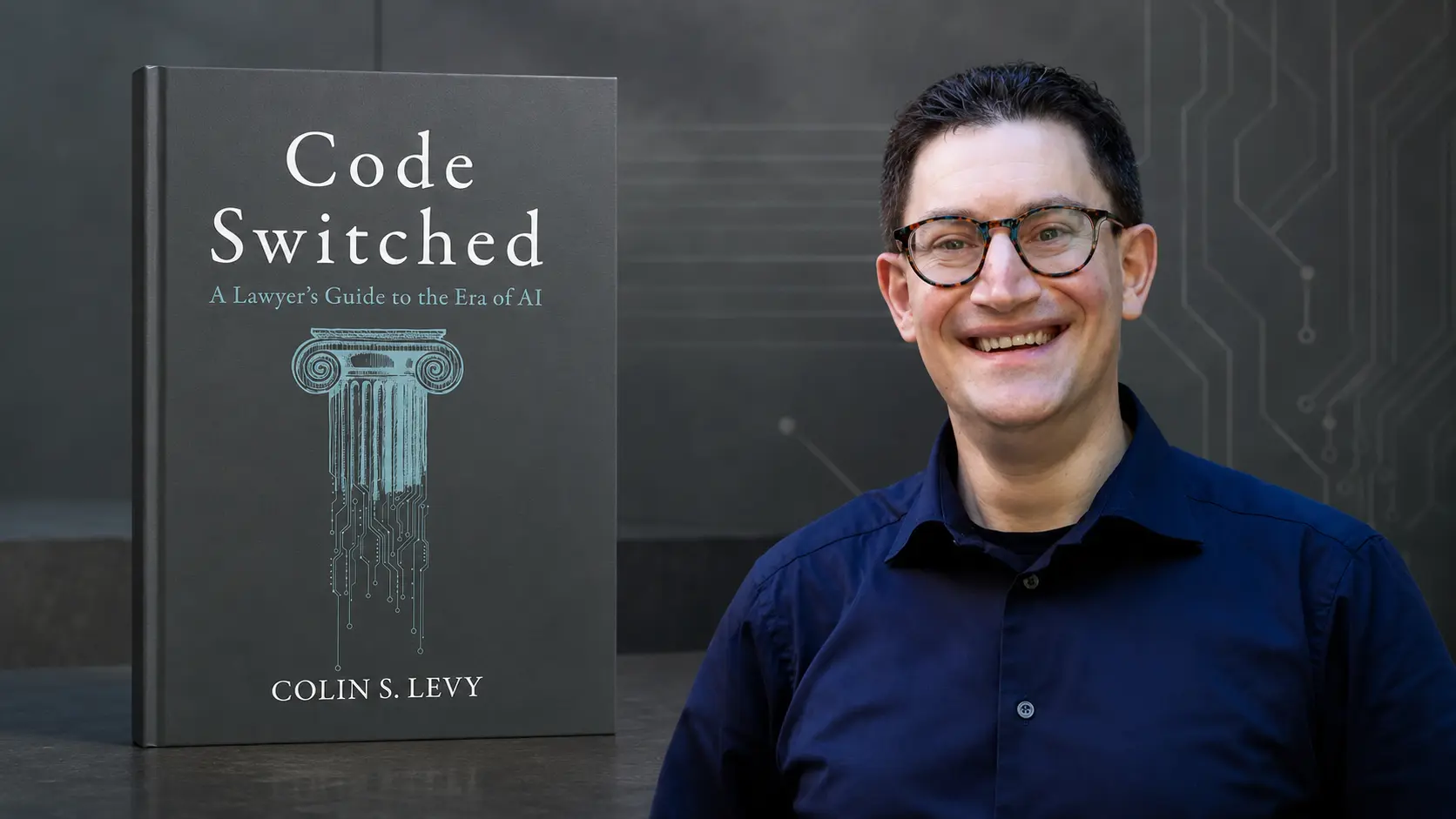
In conversation with Colin S. Levy, General Counsel at Malbek and author of *Code Switched: A Lawyer’s Guide to the Era of AI*
Key takeaways
- AI’s immediate value lies in handling pattern-based and administrative work, leaving lawyers more time for judgment.
- AI-generated work should be treated as a first draft, regardless of how polished it appears.
- Ethical AI adoption depends on disclosure, verification and human accountability.
- Durable change is more likely to come from improving one workflow at a time than attempting to rebuild an entire practice.
- The billable hour has proved considerably more resilient than early AI predictions suggested.
- Lawyers can delegate tasks to AI, but responsibility and professional judgment must remain with the lawyer.
Artificial intelligence is now capable of drafting contracts, summarising complex documents and extracting information from large volumes of legal material within minutes. What remains much less clear is which parts of legal work lawyers should actually hand over.
That question sits at the centre of Colin S. Levy’s new book, Code Switched: A Lawyer’s Guide to the Era of AI.
Colin is General Counsel at contract lifecycle management provider Malbek, an adjunct professor of law and the author of The Legal Tech Ecosystem. His latest book moves beyond mapping the available technology to examine what happens inside a working legal practice when lawyers begin delegating parts of their work to machines.
Due to be published by Amplify Publishing on Oct 5, 2026, Code Switched considers AI’s effect on daily legal work, the economics and ethics of adoption and the professional judgment lawyers must retain.
As part of our wider exploration of AI in the legal industry, I spoke to Colin about collaborative judgment, client disclosure, agentic contract systems, the resilience of the billable hour and why the most dangerous AI output may be the one that looks completely finished.
1. What’s the moment that made you want to write this book, rather than just update The Legal Tech Ecosystem?
The Legal Tech Ecosystem was a map of the terrain, useful, but written from outside the practice looking in.
What changed for me was smaller and stranger than I expected. I ran a complex commercial agreement through a generative AI tool, mostly out of curiosity, expecting a mechanical clause-by-clause summary.
Instead, it surfaced how three separate provisions interacted with each other—the kind of thing I’d have caught eventually, but only after the slow, manual cross-referencing that eats an afternoon.
It didn’t take the work away from me. It changed where I spent my attention.
That’s a different problem from “what tools exist”, and it needed a different book. Code Switched had to be written from inside a working practice, tracking what actually happens when a lawyer starts handing pieces of the job to a machine and has to decide, in real time, which pieces to keep.
2. You argue AI’s real value is amplifying judgment rather than replacing lawyers. What’s a personal example from your own in-house work that shaped that view?
Early on, I watched an AI system generate a strong first draft of a commercial agreement, capturing the business terms cleanly and saving real time.
What it couldn’t capture was a conversation from two weeks earlier, where the other side had said something informally that quietly contradicted what they’d now put in writing.
No model has access to that. It isn’t a flaw in the tool. It’s a reminder that a contract is never just the document in front of you. It’s the negotiation history, the relationship and the things people say out loud and never write down.
I call this “collaborative judgment” in the book: the AI handles the pattern work, and I hold the context the page doesn’t contain.
Once I saw that division of labour clearly in my own contracts, it became the argument for the whole book.
3. If you had to describe your own relationship with AI tools day to day, are you an early adopter who trusts the output, or someone who still double-checks everything?
I’d call myself an early adopter of the boring work and a sceptic of the ambitious claims.
Drafting, summarising and pulling terms out of a stack of contracts: I trust that layer completely now, the same way I trust a calculator to add correctly.
Where I pull back hard is anything that claims to predict how a negotiation or dispute will actually go—tools that score litigation risk or recommend a strategy based on patterns across past deals.
Those outputs get delivered with the same confident tone as a simple term extraction, but they’re guessing at things no model has access to: how a specific counterparty actually behaves once pressure is on or what a judge cares about beyond the text of a prior ruling.
I’ll take that kind of output as one data point among several. I won’t take it as an answer.
4. The book promises a path to adoption “without disrupting your practice”. Is that realistic, or does real change always mean disrupting something?
I’d push back a little on the word “disruption”.
It’s come to mean something total—a practice torn down and rebuilt from the ground up. Most durable change in law doesn’t look like that, and I don’t think it should.
What I argue in the book is that the organisations getting AI right are the ones where the technology serves the practice’s existing purposes—client service, professional judgment and ethical practice—rather than redefining them.
That’s real change. A lawyer who builds AI into one workflow at a time, checking each step against what already works, ends up somewhere genuinely different a year later.
It just doesn’t feel like an earthquake along the way, and that’s exactly why it holds.
5. Bjarne Tellmann wrote your foreword. What was it like getting his perspective on the manuscript, and did anything he say change how you framed a chapter?
Bjarne read the manuscript with the eye of someone who has actually run a legal department through more than one wave of technological change, and it showed.
The clearest mark he left is right in the introduction. He has a phrase—the “more for less challenge”—for the pressure legal departments feel as regulatory complexity grows while budgets and headcount stay flat.
He points out that US federal regulations have grown from roughly 10,000 pages in the 1950s to around 200,000 today.
That phrase gave me the frame I’d been circling without quite landing on. Before he shared it, I was describing the same pressure in scattered pieces: more rules, more risk, more expectation and less time to meet any of it.
He handed me the one idea that held all of it together, and I rewrote the opening of the book around it.
6. What’s a legal AI tool or use case you’re personally excited about right now, separate from anything in the book?
Agentic AI applied to contract lifecycle work.
I mean agents that handle the administrative choreography around a deal: routing for signature, tracking obligations after execution and flagging a renewal date against the calendar without anyone having to remember to look.
That’s unglamorous work, and it’s exactly where I think the near-term value sits.
I’ve written elsewhere about the Knight Capital incident as a warning about what happens when automated systems act faster than anyone can supervise them.
The tools I’m most excited about are the ones built with that lesson already in mind, with a human checkpoint designed in from the start rather than added after something goes wrong.
7. On the ethics of adoption, where do you personally draw the line between acceptable AI use and something that gives you pause?
The line isn’t the tool. It’s disclosure and verification.
I write in the book that legal organisations get this backwards constantly: they adopt a tool for the efficiency, then scramble to work out the ethics after it’s already embedded in how people work.
Ethics has to function as infrastructure, built in before deployment, not a checkpoint added once something goes wrong.
On a personal level, what gives me pause is the same thing that’s always given lawyers pause: using something in a way the client wouldn’t approve of if they knew, or presenting a machine’s output with more confidence than it’s earned.
The technology changes every year. What counts as candour with a client hasn’t moved in decades, and I don’t expect it to.
8. What’s the most common mistake you see lawyers make the first time they try AI in client-facing work?
Treating the first output as a finished draft instead of a first one.
AI is very good at producing something that looks complete: clean formatting, a confident tone and citations that read as plausible. That polish is exactly what makes it risky in a hurry.
I’ve seen lawyers send a client-facing summary along almost unread because it looked so clean on the screen.
The fix isn’t complicated. Read the output the way you’d read a memo from a sharp first-year associate working under deadline pressure, because that’s roughly what happened.
You’d check that associate’s citations. Check the model’s.
9. Looking back at predictions you or others made a couple of years ago about legal AI, is there one you’d happily admit didn’t pan out?
The prediction that AI would collapse the billable hour within a year or two.
I heard versions of that claim constantly, and the logic made sense on paper: if AI makes lawyers dramatically faster, clients stop paying for time and start paying for outcomes.
It hasn’t happened at anything close to that pace. The 2026 Thomson Reuters State of the US Legal Market report found that 90% of legal dollars still flow through standard hourly billing arrangements.
Firms are experimenting at the margins—alternative fee arrangements, value pricing and dedicated pricing teams—but the core model has proved far stickier than the predictions assumed.
What I underestimated wasn’t the technology. It was how slowly an entire industry renegotiates the terms of a relationship, even once the underlying economics have clearly shifted.
10. If a reader takes only one thing from Code Switched, what do you hope it is?
That the job was always judgment, and it still is.
AI can gather, draft, summarise and flag faster than any associate I’ve worked with. What it can’t do is decide what actually matters in a given moment, what risk is worth taking, what a client needs to hear and how to say it.
I call this “disciplined delegation” in the book: hand off tasks, never hand off judgment, and responsibility stays with the lawyer regardless of what produced the first draft.
Ten years from now, nobody is going to remember which lawyers moved their contracts fastest.
They’ll remember the lawyer who looked at a deal every metric said to close and told the client to walk away anyway, because something about it didn’t sit right.
That’s the instinct this book is trying to protect. AI can hand you more time. What you do with the time it hands back is still entirely on you.
About the book
*Code Switched: A Lawyer’s Guide to the Era of AI by Colin S. Levy is published by Amplify Publishing and is due for release on Oct 6, 2026. Follow Colin on LinkedIn and visit https://codeswitchedbook.com/for more information.*