HS2: A Monument to Political Failure?
HS2 was meant to symbolise national renewal. Instead it has become the clearest demonstration yet that twentieth-century governance tools cannot manage twenty-first-century projects.
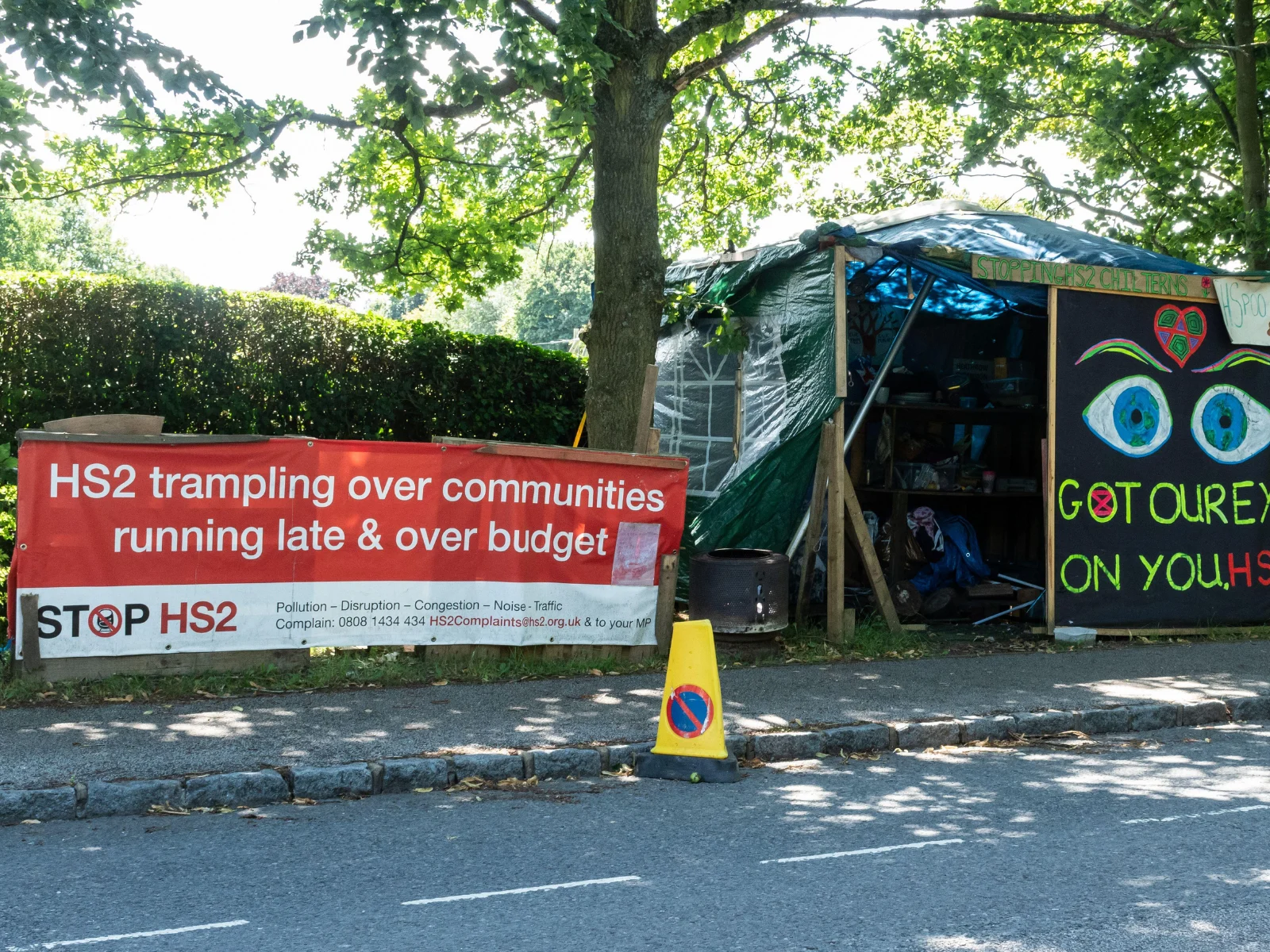
Six prime ministers. More than fifteen years. An original 2009 estimate of around thirty-seven billion pounds that has since been projected as high as one hundred billion in today's prices. More than forty-six billion already spent as of February 2026, with no agreed final cost or completion date yet published. A northern leg scrapped, a southern terminus paused, a launch date now conceded by ministers to be impossible.
HS2 has outlasted Cameron, May, Johnson, Truss, Sunak, and now stands as an inherited problem for Starmer, whose own government is currently in open crisis after a wave of ministerial resignations and growing calls from within his own party for him to set a date for his departure.
The timing is instructive. As Britain debates yet another change of political direction, HS2 sits unfinished, its purpose contested, its cost extraordinary, its accountability diffused across more than a decade of administrations that have each in turn redesigned, rescoped or rejected what came before. This is not, in the end, a story about trains.
It is a story about what happens when modern institutions are asked to deliver projects whose timeframes exceed the political cycles meant to govern them.
HS2 was conceived as a project that would reshape Britain's future. Instead, it may ultimately be remembered for exposing the limits of how modern institutions govern complexity itself.
For more than a decade, the high-speed rail programme symbolised political ambition on a national scale, a vision intended to modernise transport infrastructure, stimulate regional growth and demonstrate Britain's long-term economic confidence.
Yet as delays mounted, budgets escalated and sections of the project were abandoned, public confidence steadily deteriorated.
The reasons are now familiar: shifting political priorities, unstable leadership, escalating costs and fragmented delivery structures.
But HS2 also revealed something deeper.
It exposed how difficult modern governance becomes when institutions are overwhelmed by the scale, speed and interconnected complexity of contemporary decision-making.
When Britain Still Built for the Future
For much of the nineteenth and early twentieth centuries, Britain stood at the forefront of industrial and engineering achievement. The railways pioneered here in the 1820s did not merely transform domestic transport; they became the foundation of railway systems exported across the world. Britain built infrastructure on a scale that reshaped economies, connected cities, accelerated industry and helped define modernity itself.
HS2 was, at least in part, supposed to represent a spirit of long-term national ambition, a modern demonstration that Britain could still deliver transformative infrastructure at scale in the public interest.
At a time when many competing economies were investing aggressively in next-generation transport systems, HS2 offered an opportunity not simply to increase rail capacity, but to signal renewed confidence in Britain's ability to plan, build and think strategically for the future.
Instead, years of political inconsistency, governance failures and fragmented decision-making steadily undermined that vision. What might once have symbolised national renewal increasingly became associated with uncertainty, delay and institutional dysfunction, reinforcing concerns that Britain's infrastructure systems have too often been allowed to stagnate while other nations move ahead with greater clarity and long-term discipline.
That pattern is not unique to Britain. Stefania Caltabiano, partner at SCAI Legal and an Anglo-Italian infrastructure and commercial lawyer with extensive experience in international rail, governance and cross-border regulatory systems, draws a direct parallel from her work on Italy's high-speed rail programme:
"From my experience working in Italy on the development of the high-speed railway infrastructure, complex projects rarely fail because of engineering issues alone. More often, difficulties arise from ineffective control of timing and costs, fragmented decision-making, inadequate dispute-resolution mechanisms, and poor communication with stakeholders and local communities."
When Accountability Becomes Fragmented
Large infrastructure projects involve vast ecosystems of stakeholders. Governments, regulators, contractors, legal advisers, engineers, environmental bodies, local authorities and financial institutions all operate simultaneously within overlapping chains of responsibility.
Each generates enormous quantities of information, risk assessments and operational decisions that evolve continuously over years, often decades.
Managing that complexity requires more than administrative competence. It requires systems capable of maintaining strategic coherence across changing political and institutional environments.
In the case of HS2, that coherence gradually weakened: objectives shifted between administrations; routes were redesigned; timelines changed, public messaging evolved, and entire phases were rescoped or cancelled.
Caltabiano observes that the deeper problems surrounding HS2 reflected broader institutional weaknesses rather than purely engineering or financial failures:
"Too many stakeholders were able to influence HS2 while too few were ever fully accountable for its delivery. Over time, that instability eroded both public confidence and political trust in the project itself."
Accountability became increasingly diffuse, while confidence among both supporters and affected communities steadily declined.
The project did not collapse because rail infrastructure itself was impossible to build.
It struggled because governance systems designed for slower, less interconnected eras increasingly failed to manage modern complexity effectively.
A Crisis Larger Than Transport
This challenge is no longer confined to infrastructure.
Across sectors, organisations now face environments defined by regulatory expansion, political volatility, data overload and accelerating operational interdependence. Traditional governance structures, often reliant on siloed reporting systems, static compliance processes and fragmented oversight, are struggling to keep pace.
Why Governance Must Evolve
Artificial intelligence is beginning to change that dynamic.
Public discussion around AI often focuses on automation or disruption. Yet one of its most significant long-term implications may lie elsewhere: governance augmentation.
AI systems are increasingly capable of identifying hidden patterns across large-scale operational environments, mapping risk relationships, monitoring regulatory exposure and creating real-time visibility across interconnected systems that would otherwise remain difficult for human oversight alone to manage comprehensively.
In practical terms, this means institutions may soon govern differently.
Rather than relying solely on periodic reporting cycles and fragmented departmental structures, organisations can begin to visualise evolving risks dynamically across legal, financial, operational and strategic domains simultaneously.
Accountability chains become more transparent and decision pathways become more traceable; all of which mean that emerging governance failures become easier to identify before they escalate publicly.
The Cost of Losing Strategic Coherence
That capability matters because institutional failure rarely emerges from one dramatic mistake.
More often, it develops incrementally through accumulated ambiguity. Unclear responsibilities, delayed interventions, conflicting priorities, and inconsistent communication as well as fragmented data environments. Over time, organisations lose visibility into how interconnected risks are evolving across the system as a whole.
HS2 became a visible example of what happens when that process accelerates within a nationally significant project.
Yet it also demonstrated why the future of governance will increasingly depend upon intelligent systems capable of managing complexity at scales traditional structures struggle to sustain.
The New Infrastructure of Governance
This is particularly important for democratic societies.
Modern governments face growing pressure to deliver large-scale infrastructure, energy transition, digital regulation and economic reform within highly polarised political environments shaped by short electoral cycles and relentless public scrutiny.
Maintaining continuity across projects that span decades is becoming progressively harder.
AI-assisted governance systems cannot eliminate political disagreement or remove difficult trade-offs. But they can strengthen institutional visibility, improve accountability and help decision-makers navigate complexity with greater clarity and precision.
The future challenge for governments and corporations alike is therefore not simply technological adoption. It is governance adaptation.
HS2 may ultimately be remembered not only as a troubled railway project, but as one of the first major public demonstrations that modern institutional complexity has outgrown many of the governance tools inherited from the twentieth century.
The next generation of organisations will not be defined solely by the scale of their ambition. They will be defined by whether they possess the systems capable of governing that ambition intelligently.
Sources
Full Fact, HS2 has not cost £100 billion to date. Published May 2024. Accessed 16 May 2026. https://fullfact.org/economy/HS2-100-billion-cost-false/
Institute for Government, HS2: costs and controversies. Last updated November 2024. Accessed 16 May 2026. https://www.instituteforgovernment.org.uk/explainer/hs2-costs
New Civil Engineer, HS2: £46.2bn already spent but new total estimate not yet detailed. Published 25 March 2026. Accessed 16 May 2026. https://www.newcivilengineer.com/latest/hs2-46-2bn-already-spent-but-new-total-estimate-not-yet-detailed-25-03-2026/
New Civil Engineer, HS2 completion date could be late 2030s as anticipated final cost continues to rise. Published 15 May 2025. Accessed 16 May 2026. https://www.newcivilengineer.com/latest/hs2-completion-date-pushed-to-late-2030s-as-anticipated-final-cost-continues-to-rise-15-05-2025/
Statement to the House of Commons by Transport Secretary Heidi Alexander, 18 June 2025, confirming the 2033 launch date is no longer achievable. Reported by Xinhua, Britain delays second high-speed railway construction, again. Published 19 June 2025. Accessed 16 May 2026. https://english.news.cn/europe/20250619/7019c3e880774456868c02b4330579c9/c.html
New Civil Engineer, HS2 new cost and completion timeline estimates delayed again until end of year. Published 8 May 2026. Accessed 16 May 2026. https://www.newcivilengineer.com/latest/hs2-new-cost-and-completion-timeline-estimates-delayed-again-until-end-of-year-08-05-2026/
Wikipedia, 2026 United Kingdom government crisis. Accessed 16 May 2026. https://en.wikipedia.org/wiki/2026_United_Kingdom_government_crisis
Cited Experts
Stefania Caltabiano · Partner · SCAI Legal
Too many stakeholders were able to influence HS2 while too few were ever fully accountable for its delivery. Over time, that instability eroded both public confidence and political trust in the project itself.
Cited Law Firms
- SCAI Legal
SCAI Legal is an independent Italian law firm focused on corporate, restructuring, insolvency and international commercial law, with particular expertise in cross-border and multi-jurisdictional matters. The firm advises Italian and international companies, investors, insolvency practitioners and regulated operators on complex legal and commercial issues involving multiple jurisdictions, regulatory systems and business interests. Its work includes cross-border mergers and acquisitions, corporate structuring, governance, shareholder arrangements, insolvency and restructuring proceedings, international disputes and commercial litigation. The firm regularly supports foreign businesses establishing operations in Italy through subsidiaries, branches and representative offices, while also advising Italian companies operating internationally. Founded by dual-qualified lawyers admitted in both Italy and England and Wales, the firm combines Italian legal expertise with international commercial understanding. Founding partner Giorgio Corno is internationally recognised for his work in restructuring and insolvency, and is a former President of INSOL Europe. Stefania Caltabiano advises on corporate governance, regulated sectors, logistics and infrastructure-related matters. The firm is recognised by Global Restructuring Review among the world’s leading firms for cross-border restructuring and insolvency.