
How to Get Your Law Firm Seen by ChatGPT and LLMs
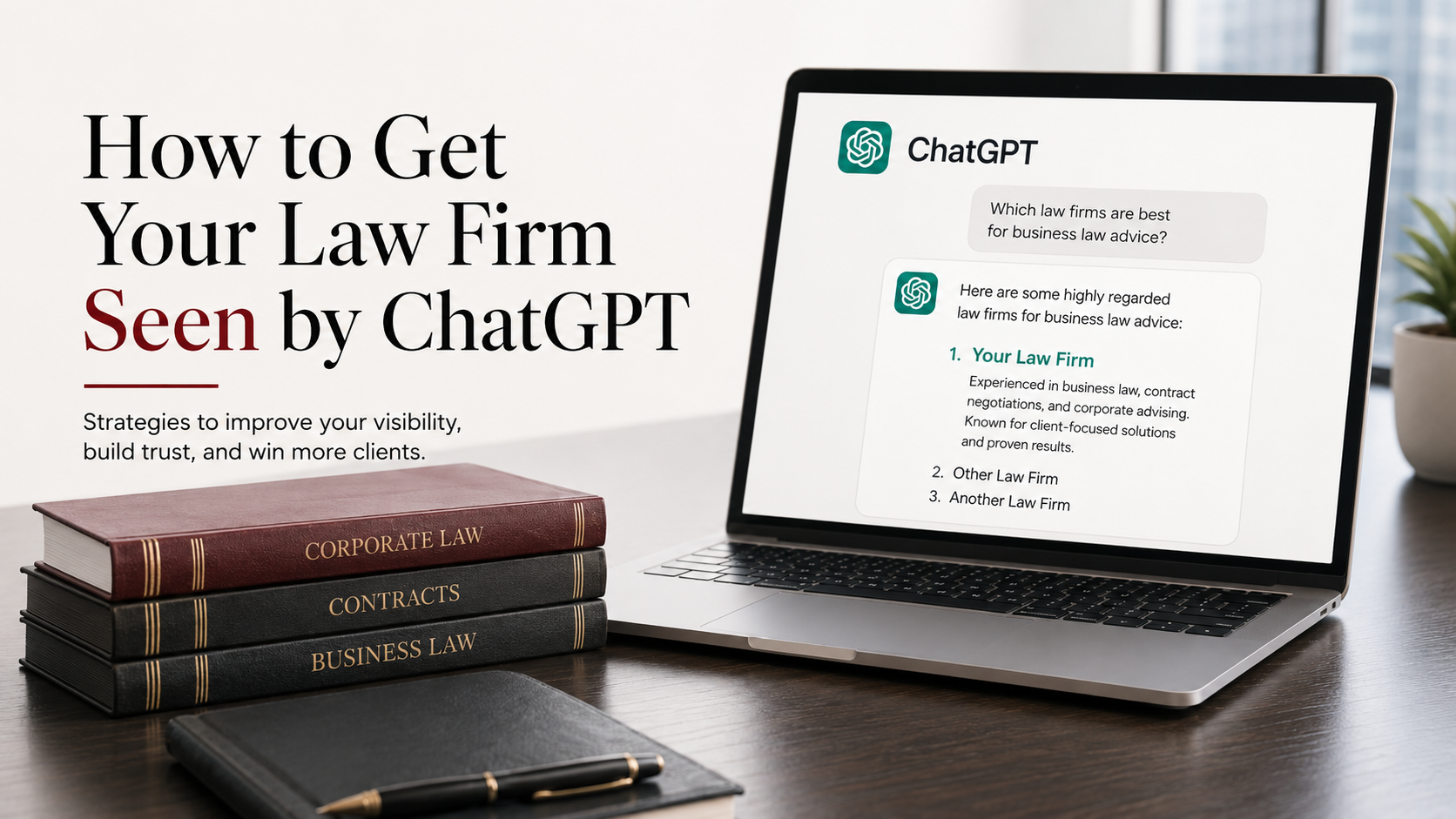
I ran 1,450 prompt tests across 335 UK law firms to see what ChatGPT and other large language models actually say when someone asks about legal services. Firms with decades of expertise were invisible. Firms with strong reputations were misrepresented. And firms that assumed their website content would translate into AI visibility discovered they were architecturally unreadable to these systems.
People are now asking AI systems for recommendations instead of searching Google. Especially in the high trust YMYL ( Your Money or Your Life) sectors such as Law. They're using ChatGPT, Perplexity, Claude, and other LLMs as research assistants, expecting accurate answers about which solicitor handles employment disputes in Manchester or who specialises in cross-border M&A. If your firm isn't structurally legible to these systems, you don't exist in those conversations.
This isn't about optimising for a new search engine. This is about making your firm's expertise, authority, and identity interpretable by machines that don't read websites the way humans do.
Why LLMs Can't See You (Even If Google Can)
Traditional SEO taught you to optimise for keywords, backlinks, and page authority. That worked because Google's algorithm rewarded signals of relevance and trust. LLMs operate differently. They don't rank pages... they synthesise answers from patterns they've learned across billions of text fragments.
When someone asks ChatGPT to recommend a family law solicitor in Birmingham, the system isn't searching your website in real time. It's drawing from its training data, from indexed sources it considers authoritative, and from structured information it can verify and cross-reference. If your firm's identity, expertise, and credentials aren't represented in those layers, the LLM has nothing to work with.
The gap isn't content volume. It's structural clarity.
I've seen firms with hundreds of blog posts get zero mentions in AI responses. I've also seen smaller firms with clean, structured profiles on trusted platforms get cited. The difference comes down to whether the information exists in a form the LLM can parse, trust, and retrieve when it needs to answer a question about legal expertise.
What LLMs Need to Recommend Your Firm
LLMs prioritise three things when generating answers about professional services: entity clarity, source authority, and verification pathways.
Entity clarity means the system can definitively identify who you are, what you do, and who you serve. This requires a single, authoritative account of your firm that doesn't contradict itself across different platforms. If your LinkedIn says you specialise in commercial litigation but your website emphasises employment law and a directory profile lists corporate transactions, the LLM sees ambiguity. Ambiguity doesn't get cited.
Source authority means the information comes from places the LLM has learned to trust. Not every website carries equal weight in the training data. Legal directories, professional association profiles, verified business listings, and platforms with editorial oversight signal credibility. A claim on your own website is weaker than the same claim corroborated by an external authoritative source.
Verification pathways means the LLM can cross-reference your expertise claims with evidence. If you say you handle intellectual property disputes, does that align with case mentions, published articles, speaking engagements, or professional certifications the system can verify? The more reinforcement points exist, the more confident the LLM becomes in citing you.
You need all three. Clarity without authority means you're well-defined but not trusted. Authority without clarity means you're credible but uninterpretable. Verification without the first two means you have evidence but no coherent identity to attach it to.
Step 1: Build a Definitive Source of Truth
Most law firms operate without a single, authoritative account of what they are. The website says one thing. The LinkedIn profile emphasizes something else. Directory listings are outdated or incomplete. Individual solicitor bios contradict the firm's positioning. This fragmentation makes you unreadable to LLMs.
You need to establish a Source of Truth - one definitive profile that answers the foundational questions an LLM needs resolved before it can recommend you.
This isn't marketing copy. This is structured identity data. Every word needs to be defensible, consistent, and verifiable. If you claim to specialise in healthcare regulatory compliance, that claim should appear identically across every platform, reinforced by case examples, credentials, and professional memberships.
The Source of Truth becomes the reference point. Every other profile, listing, and mention should align with it. When an LLM encounters your firm across multiple sources and sees the same coherent identity repeated, it interprets that as signal, not noise.
Step 2: Publish Structured Data LLMs Can Parse
LLMs don't read websites the way people do. They extract structured information from markup, metadata, and machine-readable formats. If your content exists only as prose on a webpage, the LLM has to infer meaning... and inference introduces error.
You need to make your firm's identity and expertise explicitly structured using schema markup and standardized data formats.
This markup lives in the HTML of your website and tells systems exactly what each piece of information represents. Instead of guessing whether "Jane Smith" is a person, a department, or a service, the schema explicitly labels her as an attorney with defined credentials and expertise.
Structured data also extends to your presence on external platforms. Legal directories, professional associations, and business listings that use standardized fields create additional verification points. The more places your structured identity appears consistently, the stronger the signal becomes.
Step 3: Get Indexed on Platforms LLMs Trust
Not all websites carry equal authority in LLM training data. A claim on your own site is weaker than the same claim appearing on a platform the system has learned to treat as credible.
You need to establish verified profiles on sources LLMs recognise as authoritative for legal information.
Each profile should mirror your Source of Truth. Same firm description. Same practice areas. Same solicitor credentials. Consistency across trusted sources compounds authority. Contradictions erode it.
The goal isn't to appear everywhere. The goal is to appear correctly on the platforms that matter for entity resolution. LLMs use these sources to verify claims, cross-reference expertise, and build confidence in their answers. If your firm is absent from these layers, the system has no way to validate your existence or authority.
Step 4: Create Content That Demonstrates Expertise
LLMs learn patterns of authority from how professionals communicate their knowledge. Publishing content that demonstrates genuine expertise gives the system evidence to cite when someone asks about your area of practice.
This isn't about content volume. It's about creating pieces that show depth, specificity, and professional judgment.
Write in natural language. Explain concepts clearly. Use specific examples. Avoid jargon unless you define it. The content should be useful to a human reader and interpretable by an LLM trying to understand what you know.
Publish this content on your website with proper schema markup identifying it as professional expertise. Syndicate it to platforms with editorial credibility... legal blogs, industry publications, professional association newsletters. Each published piece becomes another data point the LLM can reference when evaluating your authority.
Step 5: Build Citation Pathways for Individual Solicitors
LLMs answer questions about specific lawyers, not just firms. When someone asks for a solicitor who handles employment tribunal cases, the system needs to identify individuals with demonstrated expertise in that area.
Your solicitors need their own structured profiles, separate from the firm's identity.
These profiles should exist on your website with Attorney schema markup, on legal directories, on LinkedIn, and on any platform where individual expertise is indexed. The more verification points exist for each solicitor, the more confidently an LLM can cite them.
Individual authority compounds firm authority. When multiple solicitors at your firm have well-documented expertise in complementary areas, the LLM interprets the firm itself as a credible source across those practice areas.
Step 6: Monitor What LLMs Actually Say About You
You can't optimise for visibility if you don't know what the systems currently say. Most firms assume their online presence translates into accurate AI representation. The research shows otherwise.
Test what LLMs say about your firm by running structured prompts across multiple systems.
Run these tests across ChatGPT, Claude, Perplexity, and any other LLM your potential clients might use. Document the responses. Look for gaps, inaccuracies, and omissions.
If the LLM doesn't mention you, that's a visibility problem. If it mentions you but gets the details wrong, that's a clarity or verification problem. If it cites outdated information, that's a maintenance problem. Each gap tells you where the structural work needs to happen.
This isn't a one-time audit. LLM training data updates periodically, and the systems improve their retrieval methods over time. Regular testing shows you whether your optimisation efforts are working and where the next layer of improvement needs to focus.
Why This Matters Now
The firms that establish structural visibility early will compound their advantage over time. Every verified profile you build, every citation you index, every piece of structured data you publish... these become reference points that LLMs learn to trust.
The longer you wait, the harder it gets. Not because the work becomes more complex, but because the systems are learning patterns right now. If your competitors establish authoritative profiles before you do, those profiles become the baseline the LLMs resolve against. You'll be working to displace an existing answer instead of filling a gap.
This isn't speculative. This change in search behaviour is significant and it is measurable. People are already using LLMs as research tools for legal services. The firms that appear in those answers will indeed get the inquiries and the firms that don't exist in that layer will lose those opportunities.
Start with the Source of Truth. Make it structurally sound. Then build everything else on top of that foundation.